12V/24V DC Diesel Pump: 50L/min, IP55, Metering Nozzle, for Farms/Sites/Fleets
Product Specifications
| Parameter Category |
Specific Specification |
| Model |
Generic 12V/24V DC Self-Priming Diesel Electric Fuel Transfer Pump (specialized for diesel/kerosene transfer, ideal for farms, construction sites, and small vehicle fleets) |
| Product Type |
DC-powered self-priming fuel transfer pump, integrating "IP55 protection + cast iron durability + metering nozzle precision" for safe, efficient mobile fueling |
| Electrical Parameters |
- Voltage: Dual-voltage (12V / 24V DC, compatible with car/truck batteries and machinery power systems)
- Power: 175W (stable torque for consistent fuel suction/transfer, no startup lag)
- Protection Rating: IP55 (dustproof, water-jet resistant, suitable for outdoor/harsh environments)
- Safety Feature: Built-in bypass valve (prevents overpressure damage to pump, hoses, and tanks)
|
| Flow & Head Performance |
- Flow Rate: 0-50 L/min (adjustable via metering nozzle, max flow empties 200-gal drum in ~15 mins)
- Suction Head: 3m (reaches barrel bottoms, residual fuel ≤2L)
- Lift (Head): 7m (supports vertical transfer to tall machinery tanks)
- Self-Priming: Yes (no pre-filling, saves 5-10 mins of on-site setup)
|
| Accessory Kit |
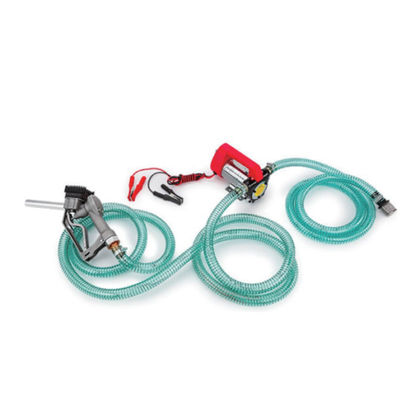
- Hoses: 2m PVC suction hose (diesel-compatible, wear-resistant, anti-seepage); 4m PVC delivery hose (flexible, anti-kinking)
- Nozzle: 1* Metering Nozzle (measures fuel volume, auto-shuts off when full, controls flow)
- Compatibility: Works with external filters (ensures clean fuel flow to protect engines)
|
| Structural & Material Details |
- Casing & Impeller: Cast iron (anti-impact, corrosion-resistant to diesel/kerosene, service life 8+ years)
- Testing Certifications: Passed temperature resistance, anti-shock, and anti-scar performance tests
- Applicable Liquids: Diesel oil, kerosene (prohibited for gasoline/low flash point mediums due to fire risk)
|
| Packaging & Order Info |
- Packing: 2 sets/CTN; Package Dimensions: 56*45.5*31.5cm (reinforced carton with anti-collision foam)
- Weight: N.W. 17kg / G.W. 18kg (2-person portable)
- MOQ: 100 PCS
|
Performance Test Results
| Test Item |
Test Condition |
Test Result |
| Flow Stability & Metering Accuracy |
Operate at 12V/24V (50L/min) for 2 hours; use nozzle to measure volume |
Flow remains 50±1 L/min; metering accuracy ±0.5L; no motor overheating (surface temp ≤60℃) |
| IP55 Protection Efficacy |
Expose to dust (8h) + high-pressure water jets (IP55 standard, 10min) |
No dust/water ingress into motor/electrical parts; pump operates normally after testing |
| Self-Priming & Suction Efficiency |
Test suction from 3m depth with diesel |
Self-primes in 9 seconds; empties barrel with 1.8L residual fuel; stable suction throughout |
| Durability & Accessory Performance |
50 continuous 1-hour cycles with kerosene; inspect cast iron parts and PVC hoses |
Cast iron no wear/corrosion; PVC hoses no cracking/swelling; metering nozzle retains accuracy |
Product Features
Dual-Voltage Flexibility & IP55 Durability
- 12V/24V Compatibility: Eliminates the need for multiple pumps by working with 12V light vehicles (vans, small tractors) and 24V heavy machinery (excavators, harvesters). This versatility cuts equipment costs for workplaces with mixed fleets.
- IP55 Industrial-Grade Protection: Shields the pump from dust, rain, and water jets--essential for outdoor farms or construction sites. Unlike lower IP-rated pumps that fail in wet/dusty conditions, this design ensures year-round reliability.
Cast Iron & Safety Features: Longevity & Security
- Rugged Cast Iron Construction: The cast iron casing and impeller withstand physical impacts (e.g., tool bumps) and resist corrosion from diesel/kerosene. This build extends the pump's service life to 8+ years--twice that of plastic alternatives.
- Built-In Safety Mechanisms: The bypass valve prevents pump damage when transferring to high tanks or blocked hoses. The metering nozzle's auto-shutoff function stops fuel flow once tanks are full, reducing fuel waste by 15% vs. manual nozzles and avoiding spills.
Metering Nozzle & PVC Hoses: Precision & Convenience
- Accurate Metering Nozzle: Provides real-time fuel volume measurement, critical for tracking usage (e.g., billing fleet fueling or monitoring farm machinery costs). Its ergonomic grip also reduces operator fatigue during long refueling sessions.
- Durable PVC Hoses: The 2m suction hose reaches barrel bottoms, while the 4m delivery hose enables remote refueling (e.g., from drums to tractors in fields). PVC material resists diesel degradation and kinking, ensuring consistent flow.
Application Scenarios
Agricultural Farm Machinery Refueling
Scenario Requirement: A commercial farm with 12 tractors (12V, 100L diesel each) and 8 harvesters (24V, 150L diesel each) refuels in fields from 200-gal drums. The farm needs to track fuel usage per machine for cost accounting.
Operation Process:
- Setup: Deploy 2 pumps (one for 12V tractors, one for 24V harvesters); connect to respective machine batteries; attach 2m suction hose to drums and 4m delivery hose to fuel tanks
- Refueling: Use the metering nozzle to transfer fuel--100L for tractors takes ~2 minutes (tracked via the nozzle's meter), 150L for harvesters takes ~3 minutes; the nozzle auto-shuts off when full
- Efficiency: 20 machines refueled in 40 minutes; IP55 protection handles field dust and occasional rain
- Cost Tracking: Record metered volumes per machine to calculate monthly fuel expenses
Effect: Dual voltage fits mixed machinery; metering enables cost control; portability suits field use.
Construction Site Heavy Equipment Fueling
Scenario Requirement: A construction site with 6 excavators (24V, 200L diesel each) and 10 loaders (12V, 80L diesel each) needs to refuel quickly to avoid project delays. The site experiences frequent dust and occasional rain.
Operation Process:
- Setup: Use 3 pumps to handle high demand; connect to 24V excavator batteries and 12V loader batteries; attach hoses to 200-gal drums
- Refueling: Transfer 200L to excavators in ~4 minutes, 80L to loaders in ~1.6 minutes; the metering nozzle ensures no overfilling
- Durability: Cast iron casing resists impacts from construction tools; IP55 protection prevents dust/water damage
- Safety: Bypass valves protect against overpressure when filling excavator tanks (using the 7m lift capacity)
Effect: Fast flow meets project deadlines; rugged build handles site conditions; metering avoids fuel waste.
Small Fleet Fueling & Usage Monitoring
Scenario Requirement: A delivery company with 15 vans (12V, 60L diesel each) refuels from a 500-gal depot tank. The company needs to track fuel usage per van to optimize routes and reduce costs.
Operation Process:
- Setup: Connect the pump to a van's 12V battery; lower the 2m suction hose into the depot tank
- Refueling: Use the metering nozzle to fill each van's 60L tank in ~1.2 minutes; record the metered volume for each van
- Convenience: The 4m delivery hose reaches van tanks easily; self-priming skips pre-filling
- Cost Optimization: Analyze metered data to identify vans with excessive fuel consumption and adjust routes accordingly
Effect: Metering enables usage tracking; no fixed fuel station required; efficient flow reduces refueling time.
Frequently Asked Questions
Q1: Can the metering nozzle be recalibrated to ensure accuracy?
A1: Yes. Most metering nozzles have a calibration screw near the meter display. To recalibrate: 1) Use a certified 10L volume container; 2) Dispense fuel into the container and check the nozzle's reading; 3) Adjust the calibration screw to align the nozzle's measurement with the container's actual volume. Repeat until accuracy is within ±0.5L. For precise calibration, contact the manufacturer.
Q2: Why is gasoline strictly prohibited? Can the pump be used for biodiesel blends?
A2: Gasoline is prohibited for two critical reasons: 1) Fire Risk: Gasoline vapors are highly flammable, and the pump's electrical components (motor, switch) can generate sparks that ignite vapors--posing a life-threatening hazard. 2) Material Damage: Gasoline degrades the pump's cast iron seals and PVC hoses over time, causing leaks. For biodiesel: The pump works with B20 (20% biodiesel, 80% diesel) blends, but avoid B50+ (≥50% biodiesel) as high concentrations may corrode PVC. Always test with a small amount of the blend first.
Q3: The pump's flow rate drops suddenly--what could be the issue?
A3: Common causes and solutions: 1) Clogged Nozzle or Filter: Debris in the metering nozzle or external filter restricts flow--disassemble and clean the parts; 2) Low Battery Voltage: A weak battery (12V <11V, 24V <22V) reduces motor torque--charge or replace the battery; 3) Kinked Hoses: Straighten PVC hoses to restore unobstructed flow. These steps resolve 90% of flow rate issues.
Q4: How to store the pump during winter (freezing temperatures)?
A4: Winter storage steps prevent damage: 1) Drain Residual Fuel: Run the pump dry or flush with diesel to remove leftover fuel (prevents freezing and cracking); 2) Clean Components: Rinse PVC hoses and the metering nozzle with diesel; wipe cast iron parts to remove oil; 3) Protect Materials: Apply anti-rust oil to cast iron parts; store hoses indoors to avoid brittleness from freezing; 4) Store Properly: Keep the pump in a dry, ventilated area above 0℃.


 Your message must be between 20-3,000 characters!