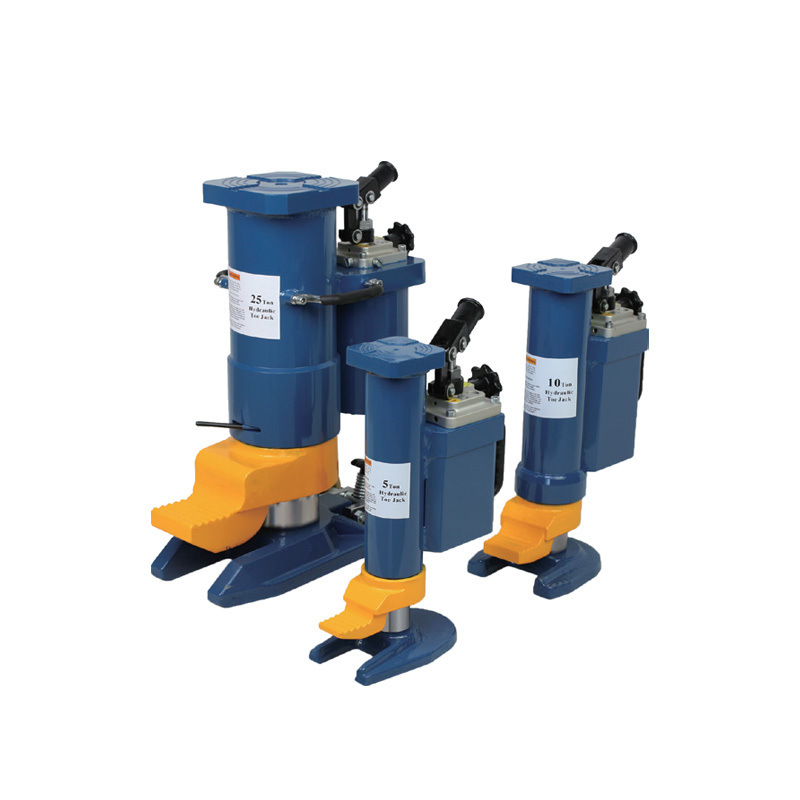
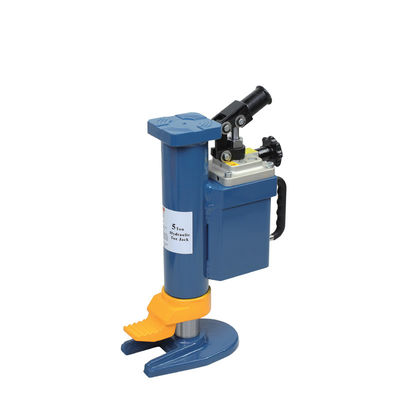
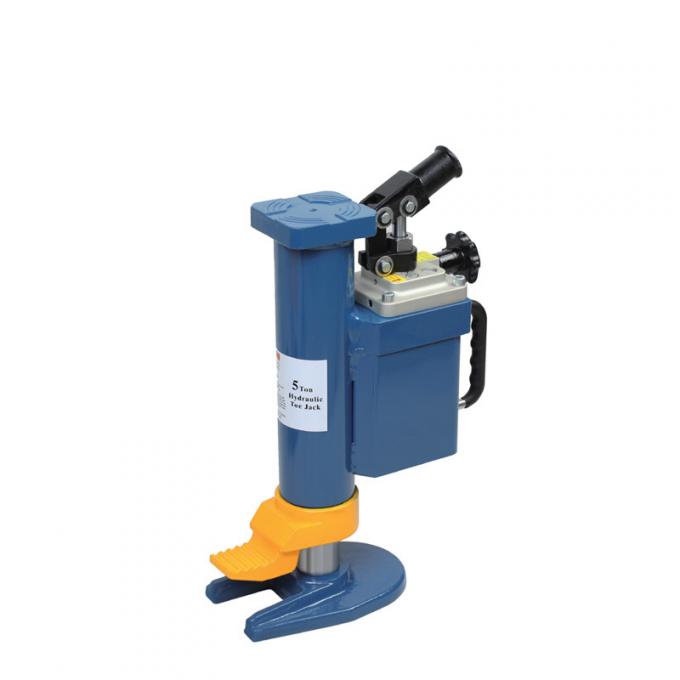
Industrial Toe Jacks (5-25T): 360° Rotation for Railway/Machinery Lifting
Product Specifications
Series Basic Information & Core Common Configurations
| Common Parameters |
Specific Description |
| Product Type |
Industrial toe jacks, covering three rated load specifications (5T/10T/25T). Specially designed for lifting railway equipment, heavy machinery, and large heavy-duty appliances, it mainly serves industrial scenarios such as railway maintenance stations, heavy machinery factories, large workshops, and logistics warehouses. |
| Core Common Configurations |
- Stable Reversed Ram Structure: Adopts a reversed ram design, which distributes force more evenly on the ram during heavy-load lifting, with a frame deflection ≤0.1mm
- 360° Rotating Housing: The housing can rotate freely 360°, allowing adjustment of the lifting angle without moving the equipment
- Controlled Descent Device: Built-in hydraulic throttle structure, which can precisely control the ram descent speed (minimum 5mm/s)
- Overload Protection Safety Valve: Complies with ANSI/ASME PALD 2009 standards, automatically cutting off the oil circuit when exceeding 10% of the rated load
- Removable Pump Lever: The pump lever adopts a plug-in design, which is easy to store and transport after disassembly
|
Key Parameter Comparison of Each Model
| Model |
Rated Capacity |
Lifting Range Of Foot (MM) |
Lifting Range Of Head (MM) |
Max. Lever Force (KG) |
N.W./G.W. (KG) |
Core Adaptable Scenarios |
| YD21-011 |
5T |
25-230 |
368-573 |
38 |
25/26 |
Light railway equipment maintenance, small heavy machine tool positioning |
| YD21-012 |
10T |
30-260 |
420-650 |
40 |
35/36 |
Medium railway turnout adjustment, 10T-class industrial motor installation |
| YD21-013 |
25T |
58-273 |
505-720 |
40 |
102/119 |
Heavy machine tool relocation, 25T-class railway bridge component lifting |
Product Details
The YD21-011 to YD21-013 Industrial Toe Jack Series is a professional equipment developed to address the pain points of "unstable lifting, difficult positioning, and uncontrollable descent in industrial heavy-load scenarios".
Reversed Ram + 360° Rotation, Dual Breakthroughs in Heavy-Load and Flexibility
- Reversed Ram Structure: Transfers the force point to the reinforced part of the frame. Combined with a 12mm thick cold-rolled steel main body (tensile strength ≥950MPa)
- 360° Rotating Housing: Allows adjustment of the lifting direction without moving the entire equipment
Controlled Descent + Overload Protection, Dual Guarantee of Safety and Precision
- Hydraulic Throttle Speed Control: Can precisely control the ram descent speed by adjusting the pressure relief valve
- Dual Safety Protection: Overload Safety Valve and High-Strength Pump Lever ensure safe operation
Wide Lifting Range + Lightweight, Dual Optimization of Adaptation and Operation
- 25-720mm Full-Range Lifting: Covers multi-scenarios from low-clearance adaptation to high-height support
- Lightweight Design: 5T model has a net weight of only 25kg, reducing equipment handling costs
Application Scenarios
Light Railway Equipment Maintenance in Railway Maintenance Stations (YD21-011)
Scenario Requirement: Maintain 5T railway track components (track bottom clearance 23mm), requiring low-clearance lifting and precise positioning
Result: Low-clearance adaptation eliminates the need for track foundation damage, and 360° rotation simplifies positioning
10T-Class Machine Tool Installation in Heavy Machinery Factories (YD21-012)
Scenario Requirement: Install a 12T CNC lathe (base clearance 28mm), requiring a load capacity of over 10T and high-height support
Result: Heavy-load bearing and controlled descent ensure installation precision
Frequently Asked Questions
Q1: Can the YD21-011 (5T load capacity) lift a 5.2T railway equipment?
A1: The overload protection will be triggered, and lifting is not recommended. The rated load capacity of the YD21-011 is 5T, with an overload protection threshold of 5.5T.
Q2: During use, the 360° rotating housing is stuck and cannot adjust the angle flexibly. What is the reason?
A2: It is mostly caused by impurity blockage between the housing and the base, insufficient lubrication, or rust on the rotating bearing.


 Your message must be between 20-3,000 characters!